
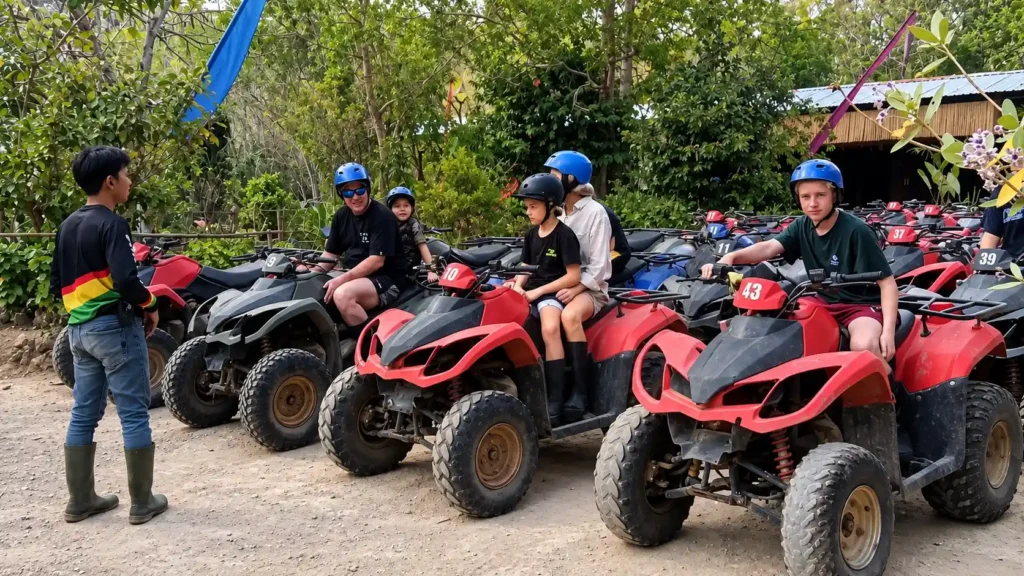
ATV riding can be an exciting way to explore Bali, but pregnancy changes the safety considerations. The question is not simply whether you feel comfortable riding an ATV, but whether the bumps, uneven terrain, vibration, and possibility of falling make the activity appropriate during pregnancy.
So, is ATV riding safe during pregnancy? Here’s what you should know before booking an ATV experience in Bali.
Is ATV Riding Safe During Pregnancy?
ATV riding is generally not recommended during pregnancy because it involves a risk of falling, losing control, or experiencing an impact. These risks are part of the nature of riding an all terrain vehicle and cannot be completely removed simply by riding slowly or wearing protective equipment.
This is important because pregnancy does not mean you need to stop being active. The American College of Obstetricians and Gynecologists (ACOG) states that physical activity is generally safe and beneficial during an uncomplicated pregnancy. At the same time, ACOG recommends avoiding activities that increase the risk of injury, falling, or abdominal trauma.
ATV riding falls into a different category from activities such as walking, swimming, or using a stationary bicycle. Those activities can provide exercise while offering more control over the environment and movement. An ATV trail, on the other hand, is constantly changing underneath you.
Why Is ATV Riding Not Recommended During Pregnancy?
The concern is less about whether riding an ATV feels physically demanding and more about what can happen during the ride. Even on a guided tour, you are still travelling over off road terrain where the vehicle can encounter bumps, slippery sections, slopes, or other obstacles.
There are three main things to consider.
1. The Risk of Falling
Falling is one of the biggest concerns when considering ATV riding during pregnancy. ACOG advises pregnant women to avoid activities that may result in a fall, and notes that changes in balance during pregnancy can make falls more likely.
That matters on an ATV because the rider has to respond to the terrain while controlling the vehicle. A change in the surface, a slippery section, or an unexpected obstacle can affect how the ATV moves.
ATV safety guidance from the U.S. Consumer Product Safety Commission also highlights the importance of training and control because riders can lose control, overturn the vehicle, or be thrown from it.
2. Uneven and Off Road Terrain
An ATV trail is not designed to provide the smooth and predictable movement you would get from a normal road. Depending on the route, you may encounter mud, rocks, slopes, puddles, river sections, or other natural obstacles.
This is particularly relevant in Bali, where ATV experiences often make the terrain part of the attraction. For example, routes can include muddy tracks, jungle paths, rivers, tunnels, and other uneven sections. These features are exactly what make an ATV adventure fun, but they also make the activity harder to predict from a pregnancy safety perspective.
ACOG recommends avoiding activities that involve a higher risk of falling or abdominal trauma rather than treating all forms of exercise in the same way.
3. The Possibility of an Impact
An ATV accident does not necessarily have to involve a serious crash to become a concern during pregnancy. A fall, collision, or sudden loss of control can result in an impact that would be difficult to predict in advance.
This is why safety equipment alone should not be considered a reason to assume that an ATV ride is suitable during pregnancy. Helmets, protective clothing, training, and responsible riding are important for ATV safety, but they do not eliminate the underlying risk of falling or being involved in an accident.
For the same reason, many ATV tour providers and booking platforms specifically state that their ATV experiences are not recommended for pregnant travelers. Current Bali ATV listings on Tripadvisor, for example, include pregnancy among the conditions for which the activity is not recommended.
You may also want to read this: Is ATV Ride Bali Dangerous? Safety Facts You Need to Know Before Booking
Can You Ride an ATV During the First Trimester?
Being in the first trimester does not automatically make ATV riding a safer choice.
You may not have a visible baby bump yet, but the risks associated with the activity itself are still there. The ATV can still move over uneven ground, encounter slippery sections, or become difficult to control. The possibility of falling or experiencing an impact does not depend on whether you are visibly pregnant.
ACOG also points out that pregnancy can affect balance and joint stability, and recommends avoiding activities that involve a higher risk of injury or falling.
If you have just found out that you are pregnant and already have an ATV activity booked in Bali, it is worth discussing the plan with your healthcare provider rather than assuming that early pregnancy makes the ride acceptable.
Is ATV Riding Safe in the Second or Third Trimester?
The second and third trimesters do not create a specific point at which ATV riding becomes safe again.
As pregnancy progresses, changes in body shape, balance, and comfort can affect how you move. ACOG notes that the shift in center of gravity during pregnancy can make you less stable and more likely to fall.
More importantly, the basic nature of an ATV ride does not change. You are still riding a motorized vehicle across terrain where falls and impacts are possible.
That is why it is better to look at the activity itself rather than trying to find a particular trimester when ATV riding might be considered safe. If you are unsure about an activity during pregnancy, your obstetrician or maternity care provider can give advice based on your individual pregnancy and circumstances.